REVIEW · TOURS
Muscat Tour Half Day
Muscat reveals its character quickly. This four-hour tour links Oman’s grandest religious building, royal landmarks, a traditional market, and a cultural museum in one tidy outing. I like the efficient route and the chance to see both polished modern Muscat and older local traditions without spending a full day in a vehicle.
I also like the small group limit of 12 and the warm, well-informed guiding associated with Said Alsadi. The main drawback is time: one hour at several stops goes quickly, and admission to the Royal Opera House and Bait Al Zubair is not included. Access to the mosque or opera facilities can also depend on opening conditions.
In This Review
- Key points at a glance
- Why this four-hour Muscat tour works
- Sultan Qaboos Grand Mosque sets the tone
- The Royal Opera House shows modern Muscat
- Mutrah Souq is the most hands-on stop
- Bait Al Zubair puts objects behind the story
- Al Alam Palace finishes with ceremony and color
- The guide can make or break a tight schedule
- Who gets the best value from $80?
- Tips for getting more from the four hours
- Should you book the Monuments and Marvels of Muscat tour?
- FAQ
- How long does the Muscat tour last?
- How much does the tour cost?
- Is pickup available?
- What is the maximum group size?
- Is admission to the Sultan Qaboos Grand Mosque included?
- Is admission to the Royal Opera House included?
- Is admission to Bait Al Zubair included?
- How much time is spent at Mutrah Souq?
- Can the public enter Al Alam Palace?
- Can I cancel for a full refund?
Key points at a glance
- The Grand Mosque anchors the morning: Allow a full hour for Oman’s largest mosque and its vast worship courtyard.
- Said Alsadi earns special praise: His friendly manner, local knowledge, and ability to pack in Muscat’s main sights are major strengths.
- Mutrah Souq adds everyday Oman: You get time for shopping, coffee, halwa, tea, spices, jewelry, and local conversation.
- Five major sights fit into four hours: The pace is brisk but useful if your stay in Muscat is short.
- Some entrances cost extra: The Opera House and Bait Al Zubair require separate admission, while the palace exterior and souq are free.
- Small groups keep the tour manageable: The maximum group size is 12, with pickup available and bottled water included.
Why this four-hour Muscat tour works
Muscat is spread out, and its main sights do not sit in one compact old center. That makes a guided half-day outing useful. You can move from the Grand Mosque to the Royal Opera House, then toward Mutrah’s older streets and the ceremonial heart of Old Muscat without spending precious holiday time sorting out the route.
The tour costs $80 per person. That is not the cheapest way to see Muscat, but the value improves if you have only a day or two in Oman, are arriving by cruise ship, or want a guide to explain the buildings rather than simply photograph them. Pickup, bottled water, and a small group are included. Entrance fees are not fully covered, so budget extra if you want to enter the Opera House or Bait Al Zubair.
The schedule fills four hours almost exactly:
- Sultan Qaboos Grand Mosque: one hour
- Royal Opera House: one hour
- Mutrah Souq: one hour
- Bait Al Zubair: 30 minutes
- Al Alam Palace: 30 minutes
That leaves little room for delays. I would choose this outing for a first look at Muscat, not for a slow, detailed museum day.
More things to do in Muscat:
- Muscat: Daymaniat Islands Snorkeling Trip with Brunch
★ 4.7 · 2,317 reviews - From Muscat: Wadi Shab & Bimmah Sinkhole Full-Day Tour
★ 4.8 · 1,862 reviews - Muscat: Wahiba Desert and Wadi Bani Khalid Guided Group Tour
★ 4.8 · 820 reviews
Sultan Qaboos Grand Mosque sets the tone
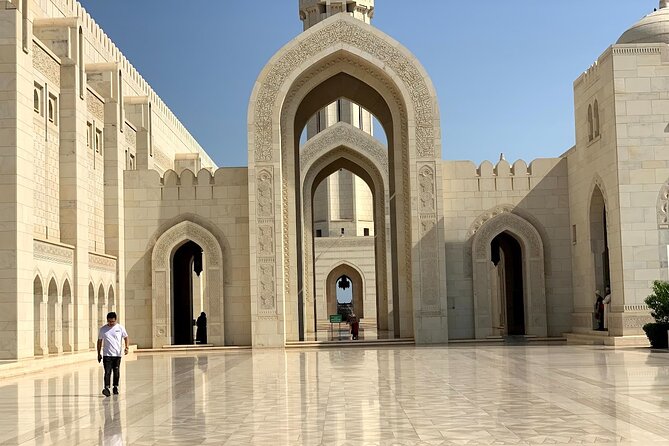
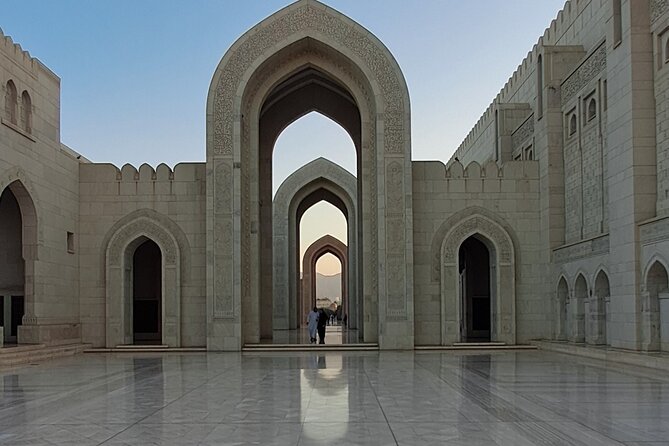
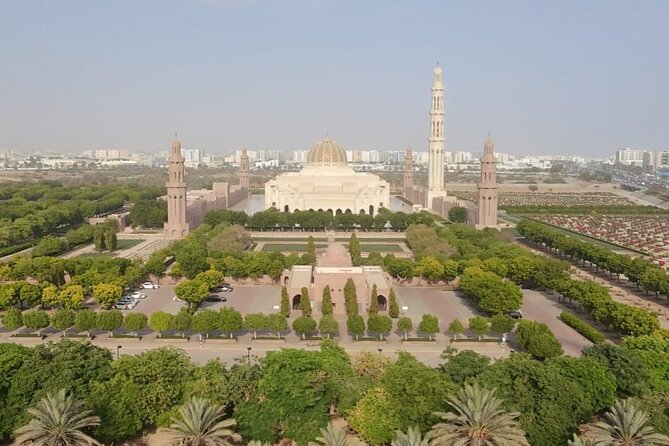
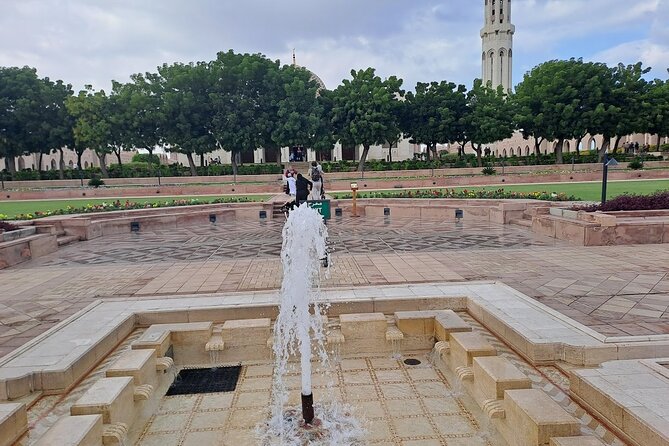
The tour begins at the Sultan Qaboos Grand Mosque, the largest mosque in Oman. It sits in the heart of Muscat and gives you an immediate sense of the country’s religious and architectural identity.
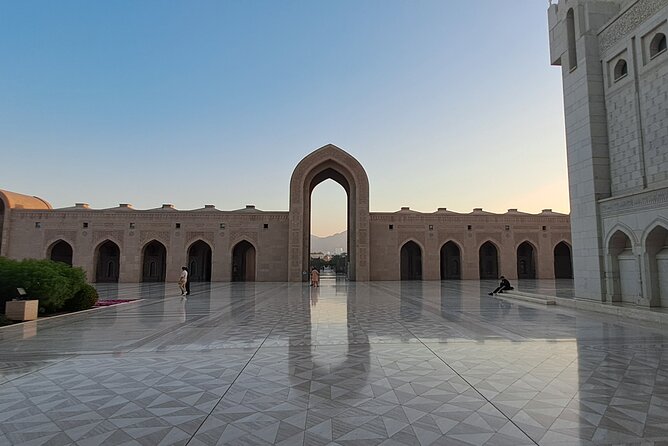
The building follows a classical Islamic style, with three main entrances leading toward spacious courtyards. The central courtyard can accommodate up to 20,000 worshippers, so scale is the main impression here. Even if you are not especially interested in architecture, the size and careful design make this a worthwhile opening stop.
You have about one hour, which is enough to appreciate the main structure, courtyards, and overall layout without turning the visit into a long architectural study. The tour includes admission to this stop, an important detail at a site where independent arrangements may take more planning.
There is one practical caution. Access can vary. One outing could not enter the mosque, even though the wider city tour still worked well. I would treat the Grand Mosque as an essential planned stop, but not assume every interior area is guaranteed on every departure. Ask about the day’s access when booking or at pickup.
The mosque is also a place where local religious customs matter. The supplied tour details do not specify dress rules, so confirm current requirements before setting out. It is wise to plan for respectful clothing whenever a mosque is part of your day.
The Royal Opera House shows modern Muscat
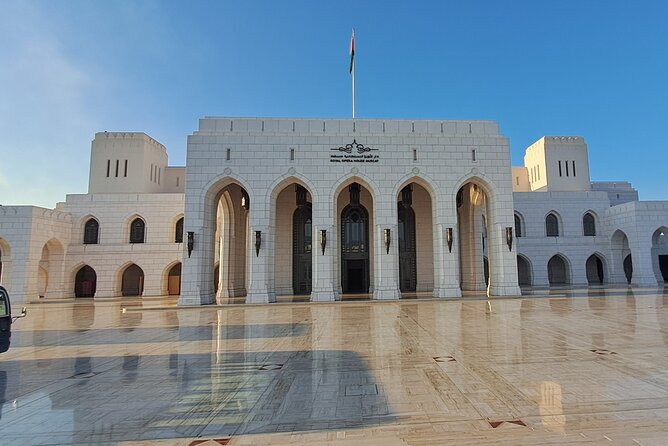
The Royal Opera House provides a sharp contrast with the mosque. Located in the Shati Al Qurum district, it is a modern performance venue built with elaborate Islamic and Omani design touches.
The exterior uses detailed patterns, while the Grand Hall has 1,100 seats. Its program can include opera, ballet, classical music, fusion performances, musicals, comedy, and other events. The venue has also presented Omani productions, including the ballet Renames, which tells a story connected to Omani culture and traditions through music and performance.
The tour allows roughly an hour here. That is useful because the building deserves more than a quick roadside photograph. You can see how Muscat presents modern cultural life while keeping strong visual links to regional design.
Admission is not included. This is one of the tour’s clearest extra-cost points, and access may depend on what is open at the time. One outing found the opera house museum closed early, so do not assume that the full interior experience will always be available.
Still, the stop earns its place. The Grand Mosque explains Oman’s religious identity, while the Opera House gives you a look at the country’s contemporary cultural ambitions. Together, they make the morning feel more rounded.
Mutrah Souq is the most hands-on stop
At Mutrah Souq, the tour shifts from grand buildings to daily commerce. This historic market is one of the oldest and largest souqs in the region, with narrow lanes, small shops, traditional buildings, and plenty of objects designed to catch your eye.
You have about an hour to wander. That is enough for a first pass, a little bargaining, and perhaps a coffee break, but not enough to inspect every lane. The market sells jewelry, spices, traditional clothing, souvenirs, and everyday supplies. Local people also use it as a place to shop and socialize, so it feels less like a museum display than a working market.
This is where I would keep a little cash and leave room in my bag. The tour does not specify a shopping budget, and prices vary from shop to shop. A guide can help you understand what you are seeing and point out items with a genuine local connection, but you should still buy only what you want.
A particularly appealing detail is the chance to stop for coffee with halwa and special tea. That small pause gives the market visit a local taste rather than making it only a shopping stop. Restaurants and cafes are also found in the souq if you want traditional Omani food, though the four-hour schedule may limit how long you can sit.
Some routes may also include a look at the fish market or other sights along the way. One account of the tour included the fish market, but the main advertised stops are the five sites listed here. Think of such additions as possible extras, not guaranteed parts of the fixed schedule.
A completely different kind of day:
- Muscat: Half-Day Sightseeing Essentials Tour and Audio Guide
★ 4.2 · 598 reviews - Muscat: Wadi Bani Khalid Oasis & Oman Desert Tour
★ 4.8 · 434 reviews - Muscat: Daymaniat Islands Snorkeling Tour with Refreshments
★ 4.7 · 426 reviews - Daymaniyat Island: Snorkelling Tour with Tasty Lunch
★ 4.8 · 403 reviews
Bait Al Zubair puts objects behind the story
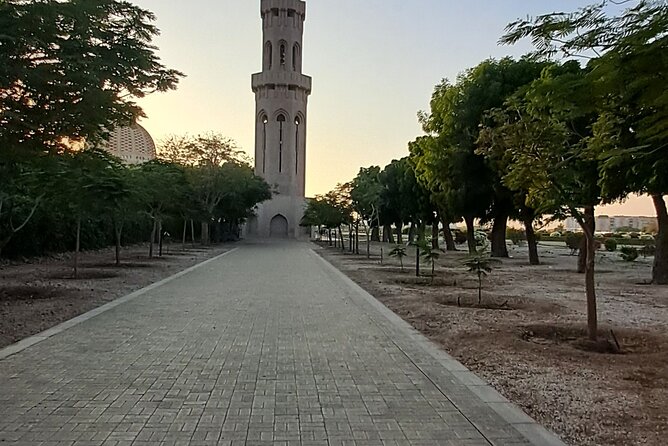
Bait Al Zubair is described as the National Museum of Oman and focuses on traditional Omani heritage and culture. Its displays cover ancient civilizations, history, art, architecture, daily life, and traditional craftsmanship.
The collection is presented through artifacts, modern exhibits, audio-visual material, and an extensive library. The site also includes heritage buildings, a traditional courtyard, and a traditional residence. That combination matters because you are not only looking at individual objects. You are also seeing the kinds of spaces and domestic settings connected to Omani life.
The allotted time is 30 minutes. I consider that an introduction, not a full museum visit. You can get a useful overview, but anyone with a strong interest in Omani history or craft may want to return independently with more time.
Admission is not included, so check the current fee before you go. The short visit also means you should listen closely to the guide’s explanations. A good guide can help you focus on the most important displays instead of rushing from case to case.
For a half-day city tour, Bait Al Zubair is a smart inclusion. The mosque and palace show official Oman. The souq shows commerce. The museum helps connect those visible parts of the city to family life, craft, and older traditions.
Al Alam Palace finishes with ceremony and color
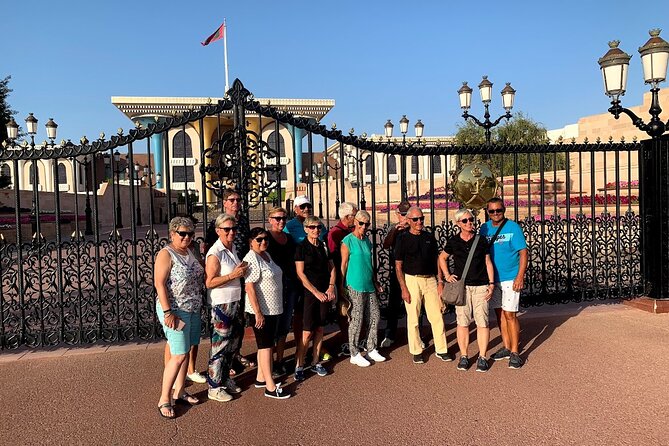
Al Alam Palace is the ceremonial palace of the Sultan of Oman in Muscat. The palace complex includes the Al-Saidiyah Palace, described as the residential wing, and the Al-Sharifiyah Palace, used for meetings, receptions, and offices for advisers and courtiers.
The palace also has gardens and a traditional majlis. The public cannot normally enter. It opens only twice a year, with tours on those occasions requiring reservations. For this half-day outing, you should expect an exterior view and time to take in the surrounding area rather than a palace interior visit.
That limitation is not a flaw in the tour. It is simply part of understanding the stop. You are seeing a working ceremonial site, not a palace museum. The free admission also keeps this final stop simple and quick.
Thirty minutes is a sensible amount of time here. After the busy souq and the museum, the palace gives you a short visual finish focused on Muscat’s government and royal setting.
The guide can make or break a tight schedule
The strongest thread running through this experience is the guide. Said Alsadi is repeatedly praised for being friendly, helpful, and well informed about Muscat. That matters because the itinerary is compact. You need someone who can explain the setting, keep the group moving, and answer questions without turning the outing into a lecture.
A good guide also helps with the gaps between the headline stops. Muscat’s story is not confined to one monument. The value comes from seeing how the mosque, opera house, souq, museum, and palace relate to one another.
The tour has a maximum of 12 people. That is small enough to keep questions practical and avoid the feel of a large coach group. Pickup is offered, which can save time in a city where the main sights are spread across different districts.
Bottled water is included. All fees and taxes are not, so ask for a clear idea of extra entrance charges before departure. The tour is confirmed at booking, and most people can participate according to the supplied information.
Who gets the best value from $80?
I would consider this tour good value for three kinds of visitors.
First, it suits anyone with only a short stay. One half-day gives you a useful sweep of Muscat’s main cultural sights, with no need to build a route from scratch. If you have only a couple of days in Oman, the tour can free the rest of your time for another part of the country.
Second, it works well for first-time visitors who want context. The buildings are impressive on their own, but a guide adds meaning to the religious, royal, commercial, and cultural sides of the city.
Third, it is practical for people who prefer a small group and pickup. A maximum of 12 is more personal than a big bus tour, while the four-hour length avoids committing your whole day.
The price is harder to justify if you already know Muscat well or plan to visit only the free exterior sights. Since the Opera House and Bait Al Zubair charge separately, the final cost can rise. You are paying mainly for the route, transport arrangement, guide, and time saved, not for an all-inclusive ticket.
Tips for getting more from the four hours
Try to start with a clear idea of your priorities. If the mosque matters most, ask about access and timing first. If shopping is your main goal, save your attention and energy for Mutrah Souq, since one hour passes quickly among its lanes.
Do not count on a long meal break. The market has cafes and restaurants, and the tour can include a coffee, halwa, and tea stop, but the schedule is built around sightseeing. Eat beforehand or plan a proper meal later.
Keep extra money available for admission fees and purchases. The tour includes bottled water, but not all taxes and fees. You may also want time to buy spices, jewelry, clothing, or souvenirs at the souq.
Finally, leave some flexibility for closures. The Royal Opera House museum has closed early on at least one outing, and mosque access was not guaranteed in another. A strong guide can adjust the day, but no short city tour can control every opening time.
Should you book the Monuments and Marvels of Muscat tour?
I would book it if you want a fast, guided introduction to Muscat and have limited time. The route covers the city’s biggest cultural themes in four hours, and Said Alsadi’s friendly guiding is a major reason this experience receives such strong marks.
I would skip it if you want long museum visits, extended shopping, or guaranteed interior access at every stop. In that case, plan the sights independently and give each one more time.
For most first-time visitors, though, $80 is a fair price for a compact orientation, especially with pickup, bottled water, and a group capped at 12. Just confirm the extra admission costs and current access arrangements before you set out.
FAQ
How long does the Muscat tour last?
The tour lasts approximately four hours.
How much does the tour cost?
The price is $80 per person.
Is pickup available?
Yes, pickup is offered.
What is the maximum group size?
The tour can have a maximum of 12 travelers.
Is admission to the Sultan Qaboos Grand Mosque included?
Yes, admission to the Grand Mosque is included in the tour details.
Is admission to the Royal Opera House included?
No. Admission to the Royal Opera House is not included.
Is admission to Bait Al Zubair included?
No. Admission to Bait Al Zubair is not included.
How much time is spent at Mutrah Souq?
The planned visit to Mutrah Souq lasts about one hour.
Can the public enter Al Alam Palace?
The palace is generally not open to the public. It opens twice a year, and visits on those days require reservations.
Can I cancel for a full refund?
Yes. You can cancel at least 24 hours before the experience start time for a full refund. Cancellations within 24 hours are not refunded. If poor weather or an insufficient number of bookings cancels the tour, you will be offered another date or experience, or a full refund.
Just added in Muscat
- Wahiba Desert Safari Adventure , Swimm in Wadi Bani Khalid★ 4.5 · 2 reviews
- Wahiba Sands & Wadi Bani Khaled (Day Trip) -“Desert Safari”★ 5.0 · 1 review
- wadi shab and bimmah sinkhole tour from muscat★ 5.0 · 2 reviews
- Wadi Shab &Bimmah Sinkhole &Heart shaped Cave &Pebble Beach★ 5.0 · 5 reviews
- Try scuba Diving Tours To Daymaniyat Islands.★ 5.0 · 12 reviews
- Wadi Bani Khalid – Wahiba Sands Desert – Sunset★ 4.0 · 1 review
- Private 2-Day Guided Tour with Nizwa Friday Market Visit★ 5.0 · 2 reviews
- From Muscat Wadi Shab and Bimmah Sinkhole Tour★ 5.0 · 6 reviews
Tours, compared.

Wahiba Desert and Wadi Bani Khalid Guided Group Tour
Read our review →
Half-Day Sightseeing Essentials Tour and Audio Guide
Read our review →

Daymaniat Islands Snorkeling Tour with Refreshments
Read our review →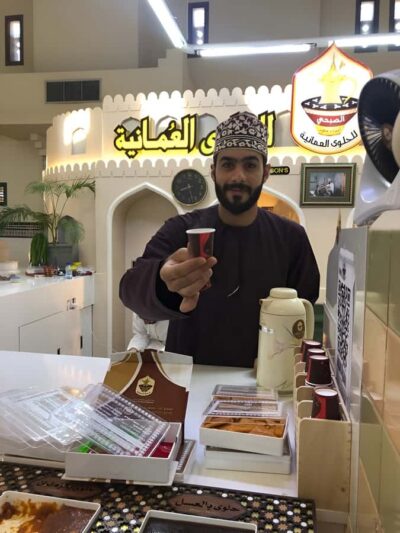

Daymaniyat Island: Snorkelling Tour with Tasty Lunch
Read our review →