
REVIEW · MUSCAT CITY TOURS
Guided Walking Tour of Sultan Qaboos Grand Mosque in Muscat
Muscat’s grandest sight rewards a slower look. This one-hour guided walk takes you through the Sultan Qaboos Grand Mosque, where Omani design, Islamic art, and quiet courtyards come together in a striking way. I like the clear focus of the visit: you see the main prayer hall, women’s prayer hall, gardens, corridors, and key architectural details without giving up half a day.
I especially like the chance to understand the meaning behind the decoration, rather than simply photographing a huge carpet and chandelier. I also like the price, $10 per person, which is modest for an English-speaking guide and bottled water. The main drawback is the short duration. One hour is enough for a useful introduction, but you may want more time if you enjoy photography, architecture, or reading every display.
In This Review
- Key points to know before you go
- Why this mosque deserves a place in your Muscat plans
- Meeting at the main entrance
- The gates, minarets, and central dome
- The marble courtyard and peaceful gardens
- The main prayer hall and its enormous carpet
- Arabic calligraphy, tilework, and the meaning behind the decoration
- The women’s prayer hall and thoughtful design
- Corridors, columns, and displays
- What the $10 price really gets you
- Clothing, manners, and practical limits
- Who should book this walking tour?
- Should you book the Sultan Qaboos Grand Mosque tour?
- FAQ
- How long does the Sultan Qaboos Grand Mosque walking tour last?
- How much does the tour cost?
- What language is the tour conducted in?
- Where do I meet the guide?
- How early should I arrive?
- What clothing is required for women?
- What clothing is required for men?
- Is transportation included?
- Is photography allowed inside the mosque?
Key points to know before you go
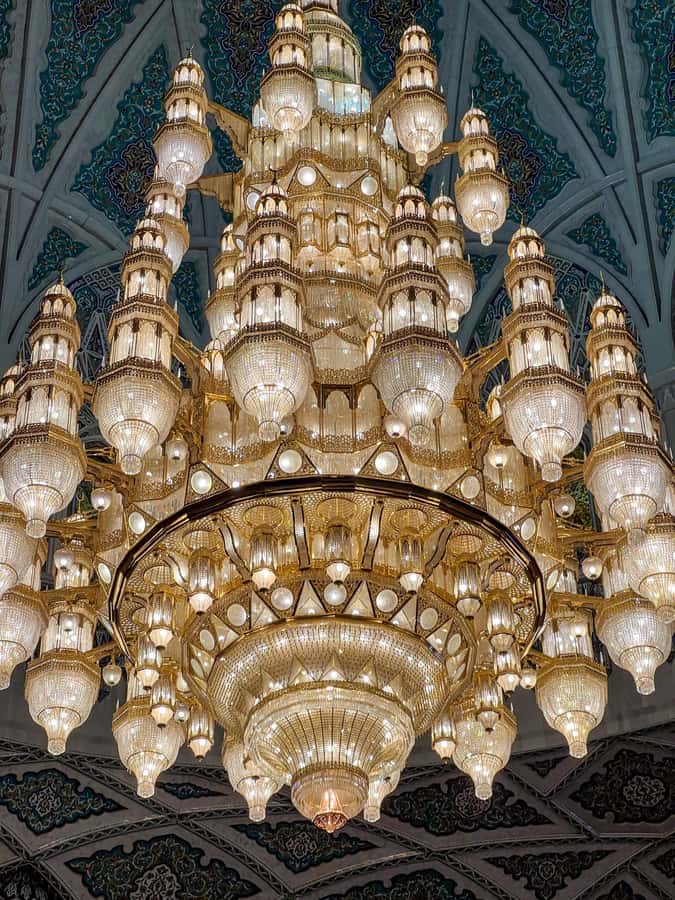
- The main prayer hall holds the visual punch: You’ll see a hand-woven carpet covering more than 4,000 square meters and a 14-meter crystal chandelier.
- The guide adds real value: Arabic calligraphy, Quranic verses, geometric patterns, and Omani design details are easier to appreciate when someone explains them.
- The visit begins at the main visitor entrance: Meet near the central gate facing the main parking area, and arrive 10 minutes early.
- Modest clothing is essential: Women need covered arms and legs plus a headscarf. Men need long pants and covered shoulders.
- The gardens soften the scale of the building: Marble courtyards, archways, greenery, and reflecting pools give the visit quiet breathing space.
- The tour costs $10 per person: That is good value if you want cultural context and an efficient first visit to Muscat’s best-known religious building.
Why this mosque deserves a place in your Muscat plans
The Sultan Qaboos Grand Mosque is not just a quick photo stop. It is Oman’s most famous architectural landmark, and the building tells you a great deal about the country’s modern identity.
The mosque was inaugurated in 2001 to mark the 30th year of Sultan Qaboos bin Said’s reign. It was conceived as a gift to the nation, reflecting his interest in faith, education, cultural renewal, and harmony. You do not need to know much about Oman before arriving, but the guide’s explanation helps you see the building as more than an enormous collection of expensive materials.
I like that the tour connects grand scale with small details. You may notice carved teakwood, patterned tilework, Arabic calligraphy, and geometric designs. These are not random decorations. They create repeated shapes and balanced spaces, giving the mosque a calm order even when you are looking at something as vast as the central dome.
The design brings together traditional Omani features with Persian, Ottoman, and Mughal influences. That mix gives the building a broader Islamic character while keeping its visual connection to Oman. A guide can point out those differences as you walk, which is difficult to do on your own in a single visit.
More Muscat city tours:
- Muscat: Half-Day Sightseeing Essentials Tour and Audio Guide
★ 4.2 · 598 reviews - Muscat: Budget Friendly City Tour
★ 4.8 · 321 reviews - Half-Day Private Muscat City Tour – Top Landmarks in Just 4 Hours
★ 5.0 · 256 reviews
Meeting at the main entrance
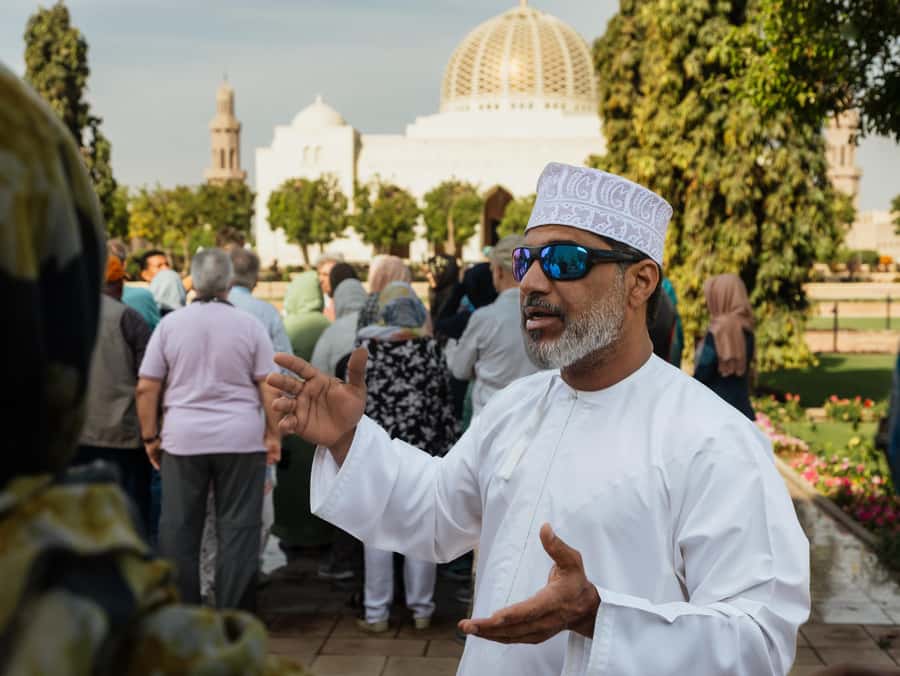
You meet your guide at the main visitor entrance, close to the central gate facing the main parking area. Look for the GidOman sign, and arrive 10 minutes before the stated start time.
That early arrival matters. The mosque complex is large, and you do not want to begin the tour by searching for the correct gate. It also gives you time to check your clothing before entering. The meeting point is not a hotel pickup location, and transportation to or from the mosque is not included, so you need to arrange your own way there.
The tour is conducted in English. A guide leads the walk and provides bottled water, a small but welcome inclusion in Muscat’s warm climate. Since the visit lasts only one hour, arriving early helps you get the full benefit of the time you paid for.
The gates, minarets, and central dome
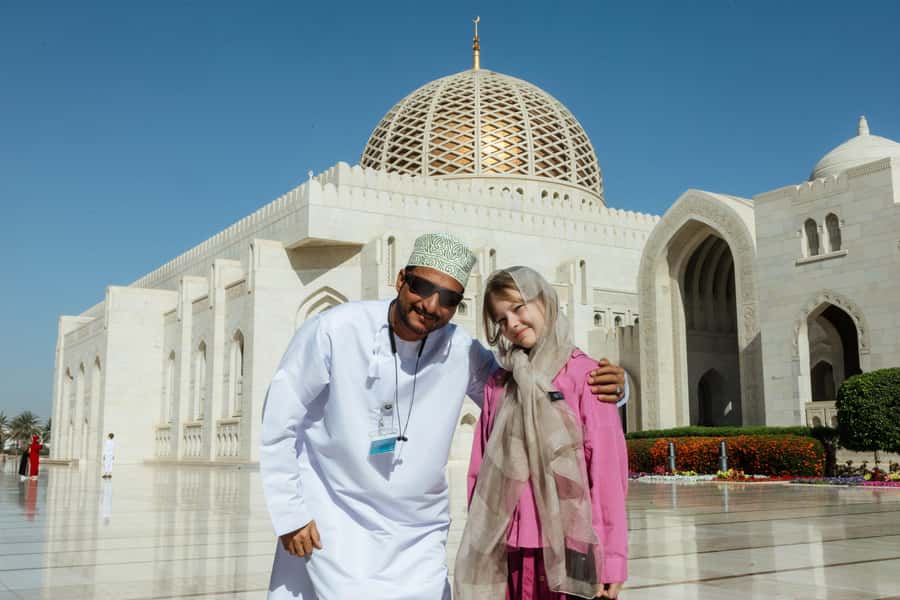
As you enter, the scale becomes clear. Five tall minarets frame the complex, with each one representing one of the Five Pillars of Islam. A central dome rises 50 meters above the mosque, giving the building a strong focal point from the courtyard.
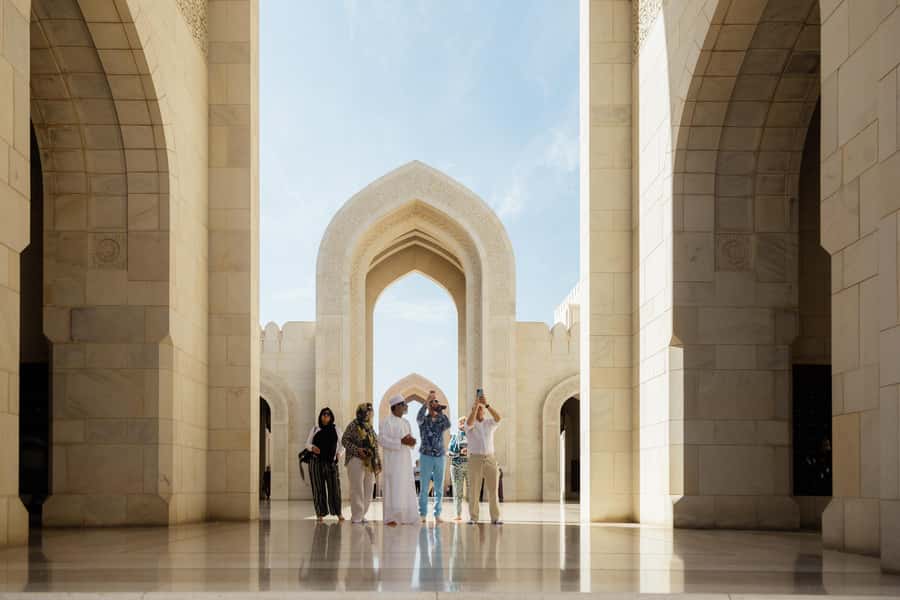
The exterior uses ivory and red-brown marble, along with elegant archways and polished columns. The effect is formal but not harsh. Sunlight catches the pale stone, while the red-brown details add warmth and keep the building from looking like one uninterrupted block of white.
This first part of the walk is a good reason to keep your camera ready, but do not rush through it. The guide can explain how Omani motifs fit alongside wider Islamic forms. You’ll also begin to see how the complex is arranged around open courtyards and gardens rather than presented as one closed interior space.
The minarets and dome make the mosque easy to recognize from a distance, but the closer details are more rewarding. Look at the arches, carved surfaces, and transitions between the large public areas. The design repeatedly moves your eye from broad shape to fine decoration.
The marble courtyard and peaceful gardens
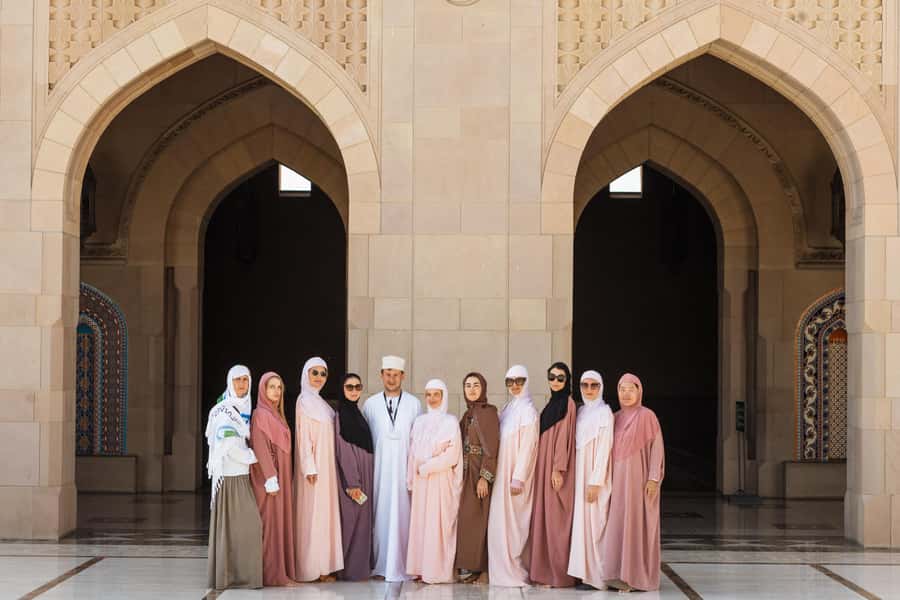
The courtyard gives the tour a welcome change of pace. You walk across broad marble surfaces bordered by floral gardens, archways, and carefully maintained greenery.
I like this section because it lets you understand the mosque’s sense of calm. The building is huge, but the gardens and open-air corridors prevent the visit from feeling like a march through one giant hall. Reflecting pools and shaded-looking garden areas, as described in the tour, also create attractive angles for photographs.
The gardens are not merely decoration. They help frame the mosque and soften its formal stonework. From different corners, you can photograph the ivory exterior, the red-brown marble, the dome, and the minarets with greenery in the foreground.
Photography is allowed in most areas, but you should keep it respectful. This is an active place of worship, not only a sightseeing stop. I would take a few careful photographs, then put the camera away long enough to notice the quiet and the proportions of the space.
More walking tours in Muscat:
- Muscat: Guided Walking Tour of Corniche, Souq & Mutrah Fort
★ 5.0 · 14 reviews - Private Full Day Guided Balcony Walk Hiking to Jebel Shams
★ 5.0 · 11 reviews - Full Day Guided Tour to Balcony Walk and Hidden Lake With Pickup Included
★ 5.0 · 8 reviews - Private Full Day Trekking In the Grand Canyon (Balcony Walk)
★ 5.0 · 4 reviews
The main prayer hall and its enormous carpet
The main prayer hall is the emotional center of the tour. Its floor is covered by one of the world’s largest hand-woven carpets, measuring more than 4,000 square meters.
The carpet took four years to weave, with 600 artisans involved in its creation. Those figures help you grasp the work behind the object. From a distance, you see a unified pattern spread across the floor. Once the guide gives you the background, you can look at it as a carefully planned piece of art made through years of patient labor.
This is where the tour guide earns the $10 price. You can recognize that the carpet is large and beautiful without help, but you may miss its pattern, symbolism, and relationship to the hall. The guide also gives you a chance to ask questions, which is useful when the decoration raises more questions than answers.
Above you hangs a 14-meter crystal chandelier decorated with hundreds of thousands of Swarovski crystals. It is an intentionally grand object, and the contrast between the delicate sparkle and the sheer size is hard to miss.
The chandelier can easily become the only thing you remember from the prayer hall, but I suggest looking beyond it. Notice the Arabic calligraphy, colorful mosaic tilework, domed ceiling, and the way repeated geometric shapes create visual balance. The hall is designed to produce awe, but it does so through order as much as scale.
Arabic calligraphy, tilework, and the meaning behind the decoration
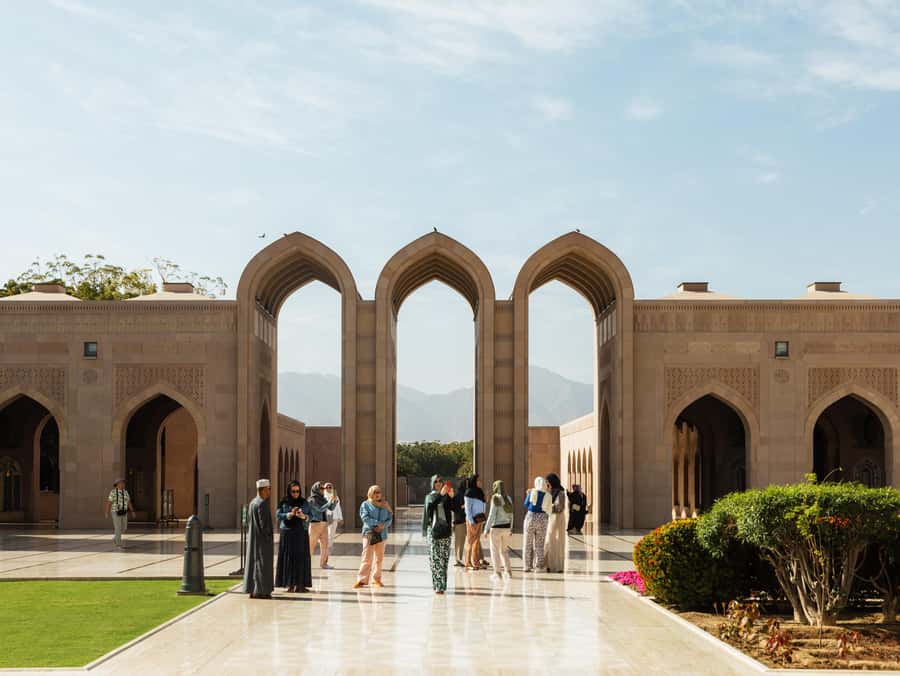
A short visit can leave you with a collection of impressive images but little understanding. The guide helps prevent that.
You’ll be shown Quranic verses and told how Arabic calligraphy is incorporated into the walls and ceiling. The geometric designs are also worth attention. Their repeated forms create a sense of harmony, and they help connect the many surfaces inside the hall.
The colorful mosaic work adds another layer. Against the marble and pale stone, the tiles provide concentrated areas of color. The result is decorative without being chaotic, since the patterns follow a clear visual system.
I appreciate that the tour treats these details as meaningful rather than using them as background decoration. If you are new to Islamic art, this is a useful introduction to the importance of pattern, script, repetition, and balance. If you already know something about architecture, you’ll have a chance to compare the Omani elements with Persian, Ottoman, and Mughal influences.
The hour moves quickly here. You may want to linger, but the guide needs to keep the group moving through the planned route. That is the tradeoff of this tour: you receive a focused explanation, not a long, unhurried study session.
The women’s prayer hall and thoughtful design
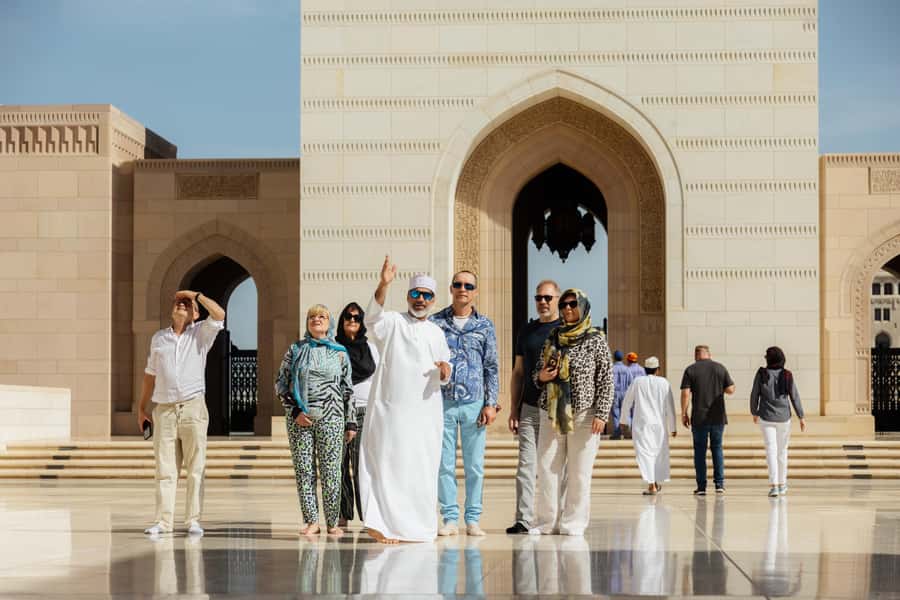
The tour also includes the women’s prayer hall. It is smaller and more intimate than the main prayer hall, but it is still richly decorated.
You can look for carved wooden doors, careful lighting, and the same attention to proportion and detail found elsewhere in the complex. This stop adds useful balance to the visit because it shows that the mosque’s design is not limited to one spectacular central room.
The women’s prayer hall also helps you understand the mosque as a working religious complex with spaces planned for different forms of worship. The design remains ornate, but its scale changes the mood. After the vastness of the main hall, this more contained space gives you a different way to appreciate the craftsmanship.
Corridors, columns, and displays
After the main rooms, you walk through open-air corridors lined with polished sandstone columns. These passages connect the major areas while keeping the complex open to air and light.
Informative displays along the corridors add context about the mosque and its design. You may find this part especially useful if you like to read and compare what you see with the guide’s explanation. The columns also make good visual frames for the gardens and courtyards beyond.
This section is less dramatic than the main prayer hall, but it gives the tour its rhythm. You move from entrance to courtyard, from grand interior to smaller prayer hall, then back into open space. That sequence makes the building easier to understand as a whole.
Comfortable footwear is a smart choice. The tour is a walking visit across courtyards, corridors, and interior spaces, and there is no point wearing shoes that make a one-hour walk unpleasant.
What the $10 price really gets you
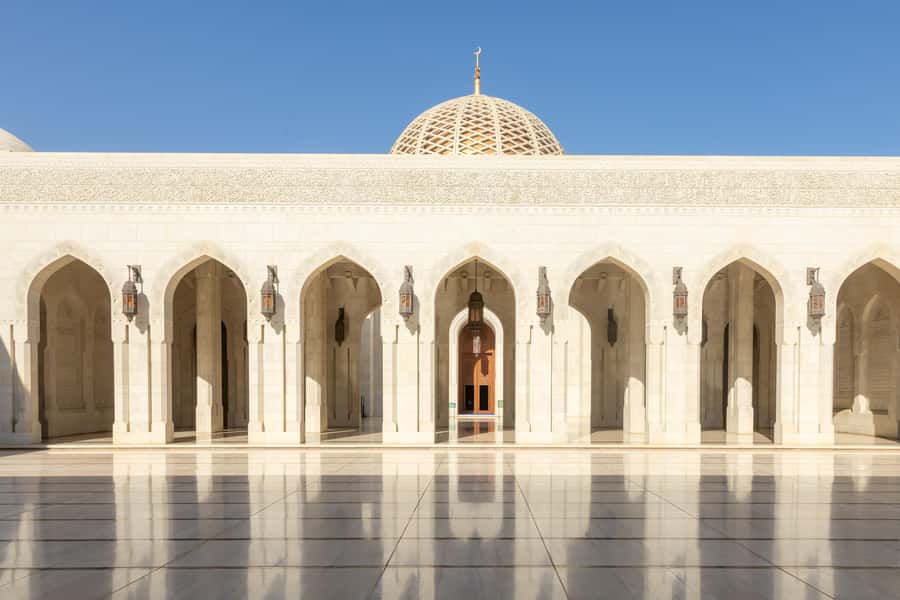
At $10 per person, this is an inexpensive guided introduction to one of Muscat’s key sights. You receive an English-speaking guide and bottled water, while transportation and suitable clothing remain your responsibility.
The value depends on what you want from the visit. If you only need to see the dome, chandelier, and carpet, you may be satisfied with a brief independent stop. If you want to know why the building looks the way it does, the guide makes the low price worthwhile.
I also like the flexibility of reserving now and paying later, with free cancellation up to 24 hours before the tour for a full refund. Those terms are useful when your Muscat schedule may change, although you should still check the available start times before booking.
The reported rating is 4.9 from 12 reviews, with repeated praise for the informative explanations and the quality of the guide. David described the visit as very informative, while Sabiha highlighted the stunning decoration and interesting information. Shari made an especially useful point: the mosque contains many small details with important meanings, and a guide helps you notice them.
One Italian visitor had the good fortune of having the guide’s full attention because the group was very small that morning. You should not assume every departure will be private, but a small group can make it easier to ask questions and hear the explanations.
Clothing, manners, and practical limits
You need to dress modestly. Women must wear long sleeves and long pants or a long skirt, and they must bring a headscarf. Men must wear long pants and cover their shoulders.
The tour does not provide a headscarf or appropriate clothing, so plan this before leaving your hotel. This is the most important practical issue because unsuitable clothing can create a problem at the entrance and distract from the visit.
Photography is allowed in most areas, but respect the religious setting. Avoid treating worshippers as photo subjects, and follow any instructions given inside the complex. The calm atmosphere is part of what makes the mosque special, so a quiet and considerate approach improves the visit for everyone.
The tour lasts one hour, which suits first-time visitors, culture lovers, and anyone fitting the mosque into a busy Muscat day. I would choose a longer independent visit only if you know you want extensive photography or time to study the displays at your own pace.
Who should book this walking tour?
I would recommend it to first-time visitors who want a clear introduction to Oman’s religious art and architecture. It is also a good choice for anyone who might otherwise look at the mosque and miss the meaning behind its patterns, inscriptions, and design choices.
The tour suits people who prefer a short, organized visit. One hour is easy to fit around other Muscat plans, and the $10 cost keeps it accessible. The English guide and bottled water make the arrangement simple once you reach the entrance.
I would think twice if you dislike guided visits or prefer to linger for a long time in one room. The tour has a fixed length, and the main prayer hall alone can tempt you to stay much longer. You also need to be comfortable walking and following modest-dress rules.
Should you book the Sultan Qaboos Grand Mosque tour?
Book it if you want meaning along with beauty. The mosque is impressive on its own, but the guide helps you understand the hand-woven carpet, crystal chandelier, calligraphy, tilework, gardens, and Sultan Qaboos’s vision for the building.
For $10, the tour offers strong value, especially for a first visit. Arrive early, dress correctly, bring your own headscarf if needed, and wear comfortable shoes. If you can spare only an hour in Muscat, this is a practical way to see the country’s most important modern mosque without treating it as just another photo stop.
FAQ
How long does the Sultan Qaboos Grand Mosque walking tour last?
The tour lasts one hour.
How much does the tour cost?
The price is $10 per person.
What language is the tour conducted in?
The live guided tour is conducted in English.
Where do I meet the guide?
Meet at the main visitor entrance of the Sultan Qaboos Grand Mosque, near the central gate facing the main parking area. Look for a guide holding a GidOman sign.
How early should I arrive?
You should arrive 10 minutes before the tour begins.
What clothing is required for women?
Women must wear long sleeves and long pants or a long skirt. Women must also bring a headscarf.
What clothing is required for men?
Men must wear long pants and cover their shoulders.
Is transportation included?
No. Transportation to and from the mosque is not included.
Is photography allowed inside the mosque?
Photography is allowed in most areas, but you should be respectful of the religious setting and follow any instructions given during the visit.
Just added in Muscat
- Wahiba Desert Safari Adventure , Swimm in Wadi Bani Khalid★ 4.5 · 2 reviews
- Wahiba Sands & Wadi Bani Khaled (Day Trip) -“Desert Safari”★ 5.0 · 1 review
- wadi shab and bimmah sinkhole tour from muscat★ 5.0 · 2 reviews
- Try scuba Diving Tours To Daymaniyat Islands.★ 5.0 · 12 reviews
- Wadi Bani Khalid – Wahiba Sands Desert – Sunset★ 4.0 · 1 review
- Wadi Shab &Bimmah Sinkhole &Heart shaped Cave &Pebble Beach★ 5.0 · 5 reviews
- Private 2-Day Guided Tour with Nizwa Friday Market Visit★ 5.0 · 2 reviews
- From Muscat Wadi Shab and Bimmah Sinkhole Tour★ 5.0 · 6 reviews
Muscat City Tours, compared.

Half-Day Sightseeing Essentials Tour and Audio Guide
Read our review →
Half-Day Private Muscat City Tour – Top Landmarks in Just 4 Hours
Read our review →
Private Muscat City Tour With Pick-up/ Drop-off
Read our review →

4 hours private Tour of Muscat City with Pick-up
Read our review →
Browse the lists this tour appears in