
REVIEW · 5-DAY EXPERIENCES
5 Days 4 Nights Oman Package Tour Mohammed
Oman rewards curiosity. This five-day private journey links Muscat’s grand mosque, old forts, coastal wadis, turtle beaches, desert camps, mountain villages, and historic towns in one well-packed route. I like the wide range of scenery, and I especially like that the tour includes a 4WD vehicle and an English-speaking Omani guide, so you are not left figuring out remote roads on your own.
I also like the human touches, such as Omani bread with honey and karak tea, the dhow-building stop in Sur, and the chance to see a desert sunset from the Wahiba Sands. The main consideration is the pace. This is an active five days, with long drives, hikes, swimming, early starts, and several stops each day. Some entrance fees also appear to need clarification, since the package says all entrance fees are included while several individual stops are marked as not included.
In This Review
- The Oman highlights you can fit into five days
- Day one: Muscat’s mosque, coast, souq, and royal forts
- Day two: Bimmah Sinkhole, Wadi Shab, and the turtle coast
- Day three: Sur, wooden dhows, and a night among dunes
- Day four: Bronze Age tombs and Oman’s high country
- Day five: Nizwa’s fort, old villages, and Jebel Shams
- What the $1,762.25 price really covers
- Who will enjoy this route most
- Should you book this Oman tour?
- FAQ
- What is the starting time and meeting point?
- Is this a private tour?
- Are meals included?
- What physical fitness level is needed?
- Are entrance fees included?
- Can I cancel for a full refund?
The Oman highlights you can fit into five days
- A private 4WD journey: Your own group travels with an English-speaking Omani guide rather than joining a large coach tour.
- Wadi Shab takes center stage: Expect a boat ride, about 35 to 45 minutes of walking, clear pools, and a narrow cave with a small waterfall.
- The route changes character daily: Muscat’s architecture gives way to beaches, wadis, turtle country, desert dunes, and high mountain villages.
- Wahiba Sands includes an overnight desert camp: You can relax, take a 4WD ride over the dunes, watch sunset, eat dinner, and sit by a campfire.
- The human side of Oman matters: Tea, bread, a dhow factory, a ghazal farm, souqs, and traditional irrigation systems add more than scenery.
- You need moderate fitness: Walking at Wadi Shab, swimming, uneven ground, heat, and long road days are part of the deal.
Day one: Muscat’s mosque, coast, souq, and royal forts
The tour begins at 8:30 a.m. from Star Tours Oman on 18th November Street, with pickup and drop-off available in the Muscat area. The first day is a city introduction, but it is not a slow one. You move from polished modern Muscat to old harbor defenses and a traditional market within a few hours.
The Sultan Qaboos Grand Mosque gets one hour. Its huge handmade Iranian carpet is the talking point: the single-piece carpet weighs 21 tons and can hold up to 20,000 worshippers. This is a striking start because the building shows both religious devotion and the scale of modern Oman.
Dress and visiting rules matter at a mosque, so modest clothing is the sensible choice. The schedule gives you enough time to appreciate the main interior features, but not enough for a long, unhurried architectural study.
Next comes the area around the Royal Opera House and Muscat’s ministries. The opera house serves as a major arts and cultural center in Oman. The stop is described as a drive around the area, with admission not included, so you should not assume you will attend a performance or receive a full interior tour.
At Qurum Beach, you get about 45 minutes for a photo stop and a taste of Omani bread with honey and karak tea. I like this pause because it breaks up the sightseeing with something local and simple. The beach itself gives you a quick look at Muscat’s coast, but this is not a long beach outing.
The Mutrah Souq is one of the day’s most useful stops. The marketplace dates back around two hundred years and is a good place to browse souvenirs. You might find silver items, frankincense, textiles, and other traditional goods, though the exact shops and products can vary.
Give yourself time to look without feeling pressured to buy. A souq is more enjoyable when you compare prices and inspect workmanship rather than making the first purchase you see.
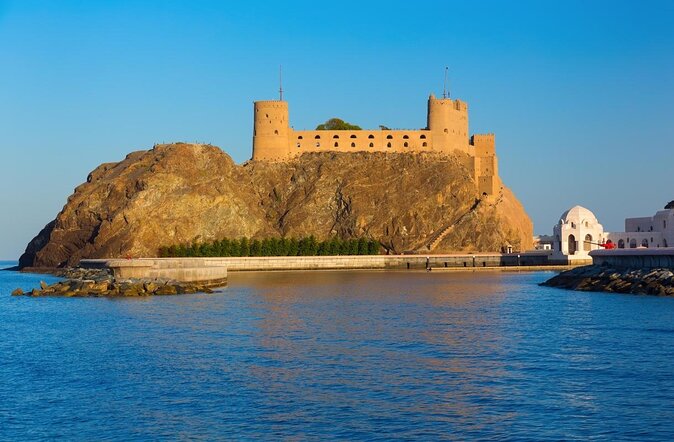
The final section of the day moves into old Muscat. At Al Alam Palace, you can photograph the blue-and-gold facade from outside. The palace is one of six royal residences and is used for official functions, but the inner grounds remain closed.
The palace is framed by Al Jalali Fort and Mirani Fort, both linked to Portuguese defenses from the 16th century. Al Jalali was built to protect Muscat’s harbor and later served at different times as a refuge and a prison. Mirani has its own military story, including an Ottoman attack and later rebuilding.
These forts are mainly photo stops rather than full interior visits. That distinction matters. You get the setting, harbor views, and historical context, but not the chance to wander through every tower and passage.
More things to do in Muscat:
- Muscat: Daymaniat Islands Snorkeling Trip with Brunch
★ 4.7 · 2,317 reviews - From Muscat: Wadi Shab & Bimmah Sinkhole Full-Day Tour
★ 4.8 · 1,862 reviews - Muscat: Wahiba Desert and Wadi Bani Khalid Guided Group Tour
★ 4.8 · 820 reviews
Day two: Bimmah Sinkhole, Wadi Shab, and the turtle coast
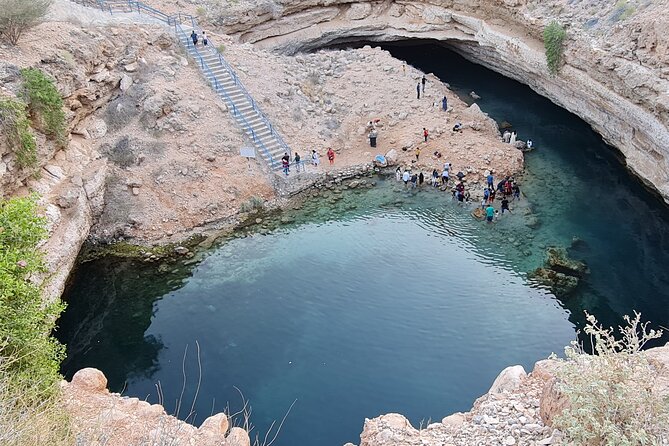
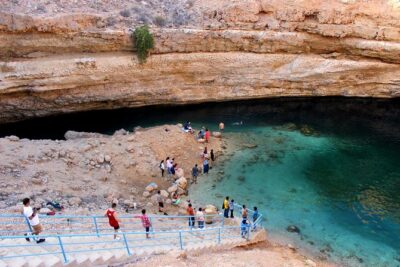
Day two leaves the city behind and becomes much more physical. You begin with Bimmah Sinkhole, a large crater near the sea with a lake at the bottom. Local explanations connect its formation with a meteor, although the provided description presents that as a belief rather than a confirmed fact.
You have about 30 minutes here. That is enough for photographs and a look at the water, but not a leisurely swim and picnic.
A short coastal stop follows at Fins Beach, known for white pebbles and clear blue water. It is another brief stop, giving you a chance to stretch your legs and take in the shore before the main activity.
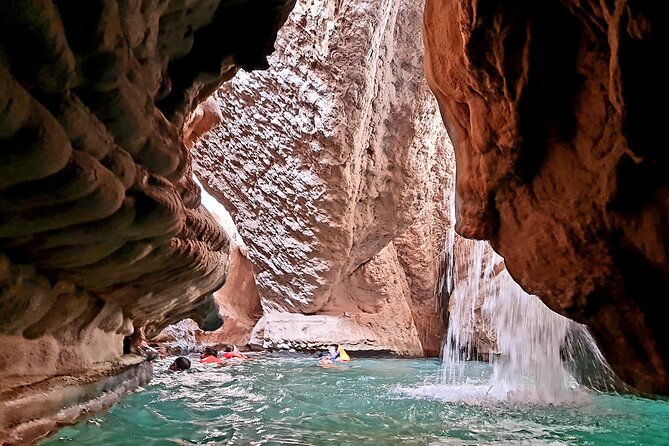
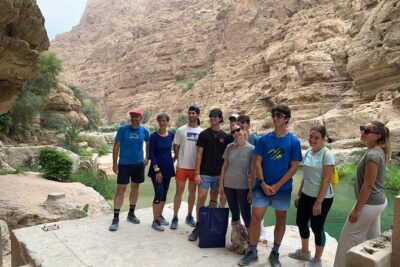
The main event is Wadi Shab, where about four hours are allocated. The route follows a canyon lined with palms and shaped by mountain water. You take a boat at the start, then walk roughly 35 to 45 minutes toward the pools, depending on conditions and pace.
This is where the fitness warning becomes real. The path is not simply a flat stroll, and you should bring sturdy footwear, water, swimwear, and protection from the sun. Once you reach the pools, you can swim through warm, clear water from one pool to the next.
The final pool leads to a narrow opening in the rocks. Strong swimmers can make their way into a small cave, where sunlight reaches the turquoise water and a waterfall drops inside. It is an excellent reward for the walk, but you should not treat the cave section as compulsory. If you are uncomfortable swimming through a narrow opening, enjoy the earlier pools instead.
I would also ask the guide about the day’s conditions before setting out. Wadi visits depend on water levels and weather, and the tour requires moderate physical fitness.
After Wadi Shab, Wadi Tiwi offers a shorter look at a greener coastal valley. Its plantations give it a different feel from the rocky canyon at Wadi Shab. The 30-minute stop is more about seeing the contrast than taking a long walk.
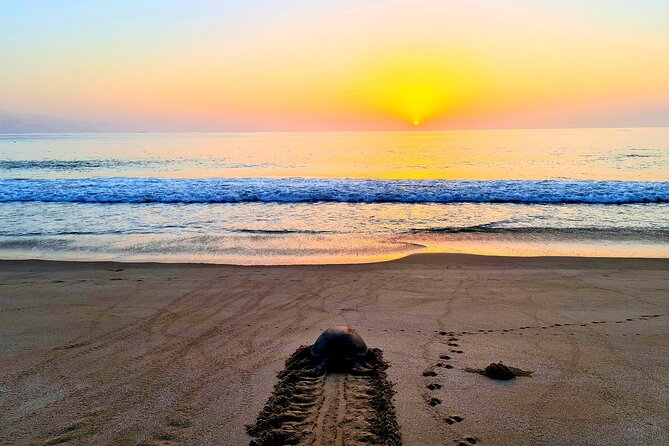
The day ends at Ras al Hadd Castle and the nearby turtle coast, with a three-hour visit and an overnight stay. Ras al Hadd and Ras al Jinz are known as breeding areas for green sea turtles. The description does not specify a guaranteed turtle-watching program, so ask exactly what is planned for the evening and what admission covers.
This overnight stop is valuable because it prevents the coast from being reduced to a rushed photo stop. It also breaks the journey toward Sur and the desert.
Day three: Sur, wooden dhows, and a night among dunes
The morning begins in Sur, a coastal city with old fortresses. The city stop lasts about 30 minutes, so think of it as an introduction rather than a detailed walking tour.
At the Arabian Dhow Factory, you can see traditional wooden boats being built. This is one of the more distinctive cultural stops because it connects Oman’s coastal life with practical craftsmanship. The visit also gives you something different from forts and scenery.
The route then continues to an Omani ghazal farm in Al Kamel, also called Asilel Farm in the description. The stop lasts around 30 minutes. Since the provided details do not explain the farm program, you should ask what you will see there and whether the visit is a guided viewing.
The afternoon belongs to Wadi Bani Khalid, one of Oman’s largest and most beautiful wadis. You have about three hours to swim, sunbathe, relax, or enjoy a picnic among the canyon walls. Compared with Wadi Shab, this stop sounds less focused on a long walk and more suited to taking your time beside the water.
Bring suitable clothing for swimming and a dry change of clothes. As always with a wadi, follow your guide’s advice about safe swimming areas.
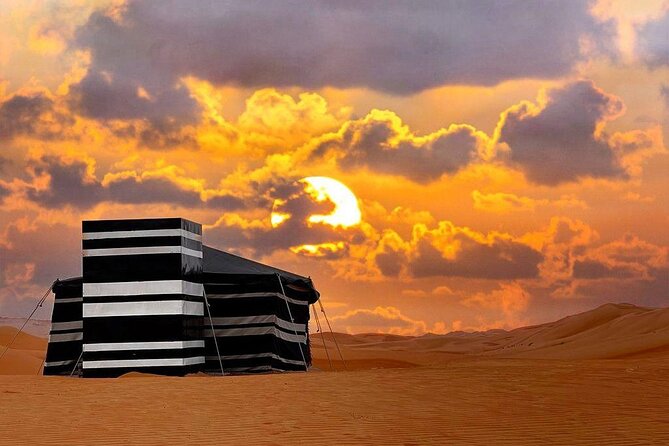
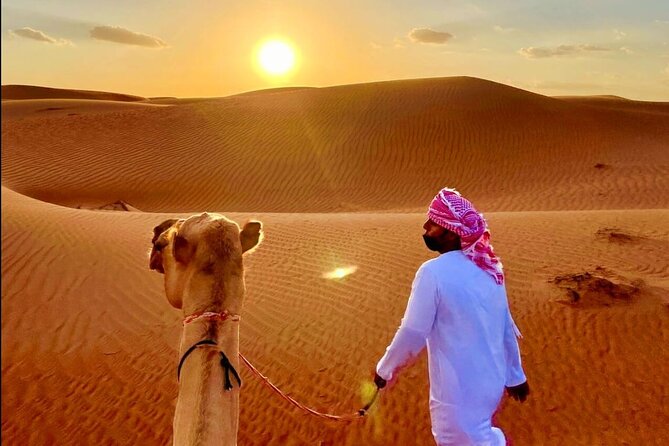
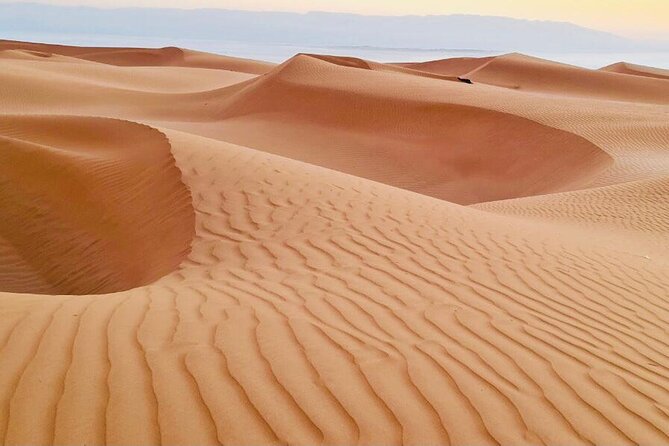
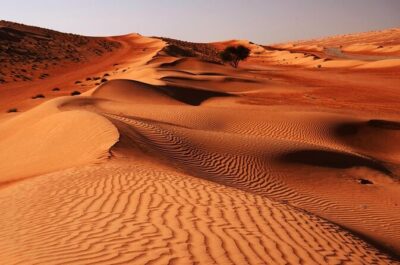
Then the scenery changes again at Wahiba Sands. You travel to a desert camp, with around four hours for dune activities and the evening. You can relax, take part in a 4WD drive over the sand, and watch sunset from a large dune.
Dinner and a campfire finish the day. Several people praised the desert portion, especially the sunset, the warm camp atmosphere, camel riding, sandboarding, and visits with a Bedouin family when those activities were arranged on their version of the trip. The supplied package specifically confirms the 4WD desert drive, dinner, and campfire, but it does not clearly promise camel riding, sandboarding, or a Bedouin-family visit. Confirm those extras before booking if they are important to you.
The camp is the tour’s most memorable overnight setting, but it is also the least conventional. You should be comfortable with a simple desert stay rather than expecting a city hotel experience.
Day four: Bronze Age tombs and Oman’s high country
Day four turns inland toward the mountains. The first stop is the Zukait Tower Tombs near Izki. These beehive-shaped Bronze Age tombs form a well-preserved archaeological site described as part of a fossilized Bronze Age setting. The site received UNESCO World Heritage recognition in 1988.
Two hours allows time to examine the tombs and the surrounding terrain. This stop is especially worthwhile if you enjoy archaeology, but the appeal is quieter than the mosque, souqs, and wadis. There are no swimming pools or dramatic activities here, so the guide’s explanation will make a real difference.
You then climb toward Jebel Akhdar, or the Green Mountain. The mountain reaches about 2,980 meters, with the Saiq Plateau at around 2,000 meters. The higher altitude brings cooler air and a sharp change from the coast and desert.
The schedule gives Jebel Akhdar two hours. That is enough for viewpoints and a sense of the mountain villages, though it may feel brief if you want a long hike or a detailed visit through the plateau.
At Birkat Al Mouz, you visit a ruined mountain village spread against the mountain face. The two-hour stop gives you more time to walk among old houses and photograph the setting. Watch your footing on uneven ground, and let the guide explain how the village fits into Oman’s mountain settlements.
The final stop is an Aflaj irrigation system, specifically the Al Kattmyn system. Five of Oman’s irrigation systems were added to the UNESCO World Heritage list in 2006. These channels show how communities moved water through dry country and maintained agriculture over generations.
The night is listed as Nizwa or Jebel Akhdar. That detail can affect the next morning’s driving time, so confirm the exact lodging location before you set out.
A completely different kind of day:
- Muscat: Half-Day Sightseeing Essentials Tour and Audio Guide
★ 4.2 · 598 reviews - Muscat: Wadi Bani Khalid Oasis & Oman Desert Tour
★ 4.8 · 434 reviews - Muscat: Daymaniat Islands Snorkeling Tour with Refreshments
★ 4.7 · 426 reviews - From Muscat: Nizwa and Oman’s Historical Gems Tour
★ 4.7 · 403 reviews
Day five: Nizwa’s fort, old villages, and Jebel Shams
The final day begins with Nizwa Fort, one of Oman’s best-known historic sites. Nizwa was once the capital, and the fort now functions as a museum with views over the old town and nearby mountains.
You have one hour here. I would use it for the main tower, defensive features, museum displays, and the town views. If you are passionate about fort architecture, the time may feel tight.
Next comes Nizwa Souq, with an hour to browse silver crafts and handmade goods. This is a practical place to shop for a lasting reminder of Oman, but remember that the package does not include personal purchases. The souq also helps connect the fort’s political past with the town’s continuing commercial life.
In Al Hamra Old Village, you get another hour among older houses. The village adds a sense of how homes were built and arranged before modern development. The stop is free according to the supplied details, while the following visit to Misfat Al Abryeen has admission marked as not included.
Misfat Al Abryeen is a mountain village with some of Oman’s oldest preserved houses. You have an hour to walk and photograph the settlement. Expect uneven surfaces and a need for sensible shoes.
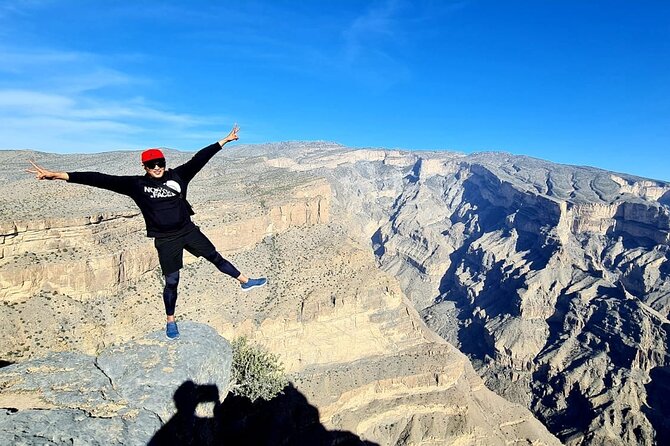
The last major stop is Jebel Shams, called the Grand Canyon of Oman. The mountain is listed at about 3,009 meters, and the views are the payoff for the long route through the interior. Three hours are allocated before returning to Muscat.
That return makes the final day long. You should not plan an evening flight immediately after the tour unless the operator confirms the timing and transfer arrangements.
What the $1,762.25 price really covers
At $1,762.25 per person, this is not a budget sightseeing outing. Its value comes from the amount of ground covered and the fact that you receive private transport, an English-speaking Omani guide, bottled water, accommodation, four breakfasts, three dinners, and a 4WD vehicle.
The private format matters. Your group can receive direct help at Wadi Shab, ask questions about Omani culture, and discuss adjustments with the guide. Several experiences have praised guides by name, including Saif, Ahmed, Majid, Musab, Qambar, and Saied. The strongest pattern is personal care: guides were described as patient, flexible, hospitable, helpful with photographs, and good at explaining local culture and history.
The package also lists group discounts, so the per-person price may work better for two or more people sharing the private vehicle and rooms. Accommodation arrangements vary by party size: a single room for one person, one double room for two, one double with an extra bed for three, and two double rooms for four.
I would clarify three money matters before paying:
- Which entrance fees are truly included, since several stops are marked not included.
- Which dinners are covered, since the inclusions list three dinners but the notes mention dinner not included from the hotel.
- What standard of accommodation is provided at Ras al Hadd, Wahiba Sands, and Nizwa or Jebel Akhdar.
Lunch is not included, so budget for five midday meals and any snacks or drinks beyond the bottled water supplied.
Who will enjoy this route most
I would choose this tour if you want Oman’s major contrasts without renting a car or arranging several separate hotels. It suits couples, families with active older children, and small private groups that value a guide’s help.
You should be ready for a busy schedule. Wadi Shab requires walking and swimming, the mountain villages involve uneven ground, and the route includes long drives. The tour is not the right fit if you want slow mornings, long stays at each beach, or a deep museum-focused trip.
Good preparation is simple:
- Wear modest clothing for the Grand Mosque.
- Pack walking shoes, swimwear, sun protection, and a change of clothes.
- Carry a small bag for wadi stops rather than bringing everything from the vehicle.
- Ask about weather and water conditions before Wadi Shab.
- Confirm desert extras, accommodation, and entrance fees in writing.
- Leave room in your schedule on the final night because returning to Muscat from Jebel Shams takes time.
Should you book this Oman tour?
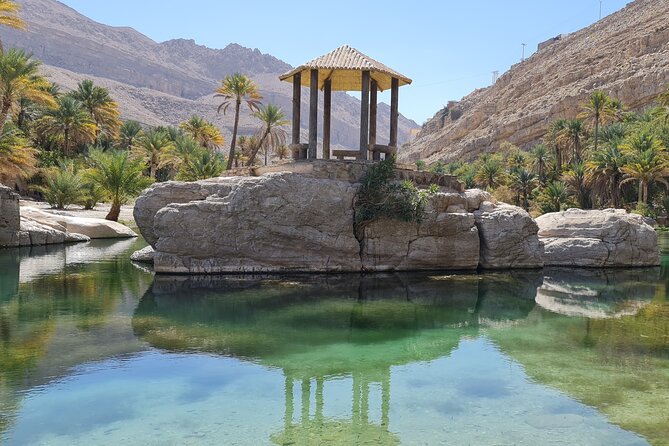
I would book it if your goal is variety. In five days, you see Muscat’s royal and religious architecture, the coast, two major wadis, turtle country, Sur’s maritime traditions, Wahiba Sands, Bronze Age tombs, Nizwa, old villages, and Oman’s highest mountain areas.
I would hesitate only if you dislike active days or want every cost fixed in advance. The route is ambitious, and the entrance-fee wording needs clarification. Ask the operator to confirm the hotel names, desert activities, dinner arrangements, and admission costs.
For an active first look at Oman, the tour offers strong value through its private 4WD transport and human guide service. The best moments are likely to come from the contrasts: warm water in a canyon, sunset over sand, tea at the coast, and old villages beneath high mountain cliffs.
FAQ
What is the starting time and meeting point?
The tour starts at 8:30 a.m. from Star Tours Oman on 18th November Street in Muscat. Pickup and drop-off are offered in the Muscat area, and the activity ends back at the meeting point.
Is this a private tour?
Yes. Only your group participates in the activity, and transportation is provided in a comfortable 4WD vehicle.
Are meals included?
The package includes four breakfasts and three dinners. Lunch is not included. The dinner arrangements should be confirmed because the information also notes that some hotel dinners may not be included.
What physical fitness level is needed?
A moderate level of physical fitness is recommended. Wadi Shab includes a boat ride, a hike of about 35 to 45 minutes, and swimming between pools. Other stops involve walking on uneven ground and spending time outdoors.
Are entrance fees included?
The inclusions list says all entrance fees are included, but several individual stops are marked as admission not included. Ask Star Tours Oman to confirm exactly which sites and fees are covered before booking.
Can I cancel for a full refund?
You can receive a full refund if you cancel at least three full days before the local start time. Cancellations or changes made within three days are not accepted for a refund. If poor weather causes the experience to be canceled, you will be offered another date or a full refund.
Just added in Muscat
- Wahiba Desert Safari Adventure , Swimm in Wadi Bani Khalid★ 4.5 · 2 reviews
- Wahiba Sands & Wadi Bani Khaled (Day Trip) -“Desert Safari”★ 5.0 · 1 review
- wadi shab and bimmah sinkhole tour from muscat★ 5.0 · 2 reviews
- Try scuba Diving Tours To Daymaniyat Islands.★ 5.0 · 12 reviews
- Wadi Bani Khalid – Wahiba Sands Desert – Sunset★ 4.0 · 1 review
- Wadi Shab &Bimmah Sinkhole &Heart shaped Cave &Pebble Beach★ 5.0 · 5 reviews
- Private 2-Day Guided Tour with Nizwa Friday Market Visit★ 5.0 · 2 reviews
- From Muscat Wadi Shab and Bimmah Sinkhole Tour★ 5.0 · 6 reviews
5-Day Experiences, compared.
5 Days – 4 Nights Private Roundtrip Tours – Fatimah Tours
Read our review →

Oman Explorer: City, Wadis, and Desert 5-Day Adventure
Read our review →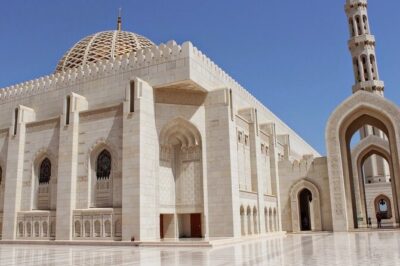

The Oman Essentials Tour with Fully Live Guided Tour – 5 Days / 4 Nights
Read our review →Browse the lists this tour appears in